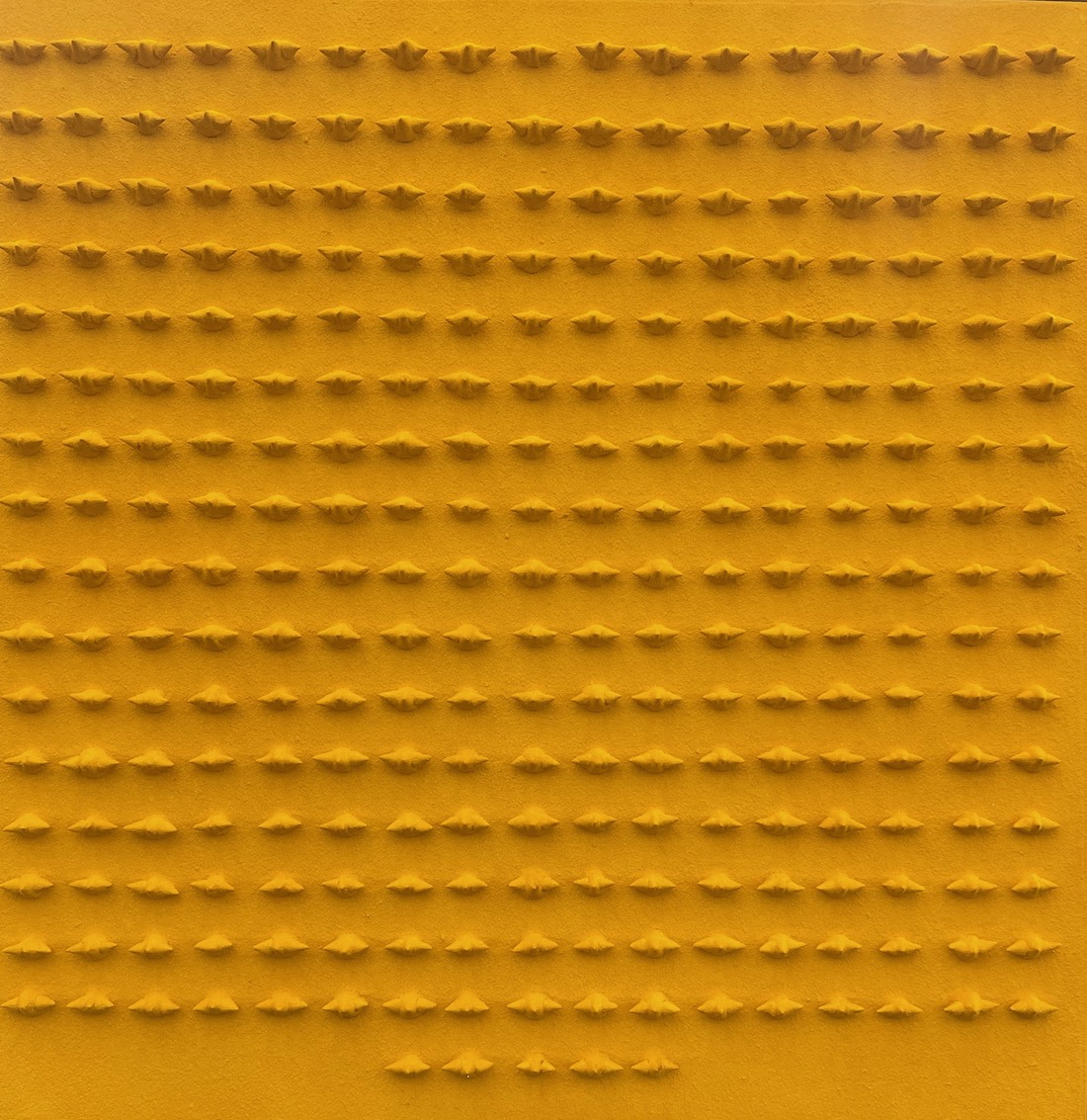
Sifr is a solo exhibition by artist, scholar, and educator Gunjan Chawla Kumar, shaped through the exhibition text and programming by Anushka Rajendran. Bringing together over 60 new works, the exhibition explores natural pigments, earth materials, and the idea of zero as both void and vessel. The works span drawings, paintings, and sculptural forms created with clay, handwoven cotton, and earth sediments from India and Chicago, extending the artist’s long-standing research into archaeological and craft histories.
The exhibition will be on view from 11th December ’25 to 15th January ’26, at Exhibit 320’s newly expanded space in Lado Sarai.
‘Sifr‘ Show Note By Anushka Rajendran
Sifr denies and claims totality at the same time. It is a rebellious figure that refuses fixity and binary to find movement in stillness. The whirling dervish pauses mid-moment for an eternity, reverberating the energy of a restless particle that captures the gravitational dynamics of the universe and its smallest of its constituents. Zero is the ether to Gunjan Kumar, an all-pervading vessel that is able to contain the unrest of all the worlds. Sifr finds form in Gunjan Kumar’s subtractive aesthetics, in primary colours and cone, a primary form whose essential constituent is movement, each spiral flick of the hand collapsing into its formation. In times of unrest marked by collective mobilization on one hand and annihilation on the other, in Sifr we are able to find affective modalities of dialoguing with one another, in the motions of a lone studio process, tethered to the world around us.
This exhibition brings together long-term work by Gunjan Kumar as part of the series Sifr which situates metaphysical considerations on matter, molecule and movement, that are inspired at the same time by the String theory, Sufism, non-western philosophy and a childhood spent with verses of Bulla Shah and Shah Husain in the voices of Fakirs, the sound of Gurbani and Shakesphere mixed with local folktales. Gunjan’s practice as it appears to us in this exhibition locates its origins in extensive travel undertaken by the artist, to engage with artisans around the country, primarily working with textile and also beyond in Gujarat, Kashmir, Bihar and Banaras. These learnings were the starting point for later inspiration from Japanese mineral painting and the pigments of the Bhimbhetka caves. Gunjan allows herself to be swept up by each of these multifarious strands of investigation, so that when she turns to the refuge of the studio, she is able to contemplate the points of simultaneity among them and distill their concurrency into the plurality of specks of pigment.
This is a practice where the artist’s process supersedes the art object, which becomes incidental, and meaning making is contingent on the coming together of material, space and encounter. This two-fold signification of the fleeting presence and absence of discursivity in her work finds articulation in a series of works with muslin and pigment where missing parts find themselves in the other to form a whole. In her process which is repetitive, she arrives from other influences to the Deleuzian notion of repetition with difference. Each repetitive iteration of the same gesture produces a different meaning that is circumstantial, leading to new possibilities and connections, and with it, the opportunity to view from a distance, observe as if it were being made anew. Similar sensibilities extend to the exhibition space as well. The works when viewed together situate parts, as if they collectively frame a microcosm of lived experience, where not one element alone is able to lay claims to representation in any holistic sense. In an immersive state, within this exhibition space perhaps, we are able to commune with each gesture that informs this body of work. The gaze of the visitors to the exhibition animates them, completing even if for a moment the destiny of the work in space. In a world where all truths are perceived, circumstantial, evidentiary and contingent, where incongruity and unrest seem to the perpetual momentum that moves us forward, from a sensible order of visibility and invisibility, for one part implies the missing others, the artist arrives at an ethical core to read social geometries. In its making, and re-making upon encounter with the viewer, the works enact historical processes in relation to the contemporary and the lessons from archetypes in mythology and psychoanalysis.
In repetition also lies the possibility of resistance, for the rewriting of structures and systems that no longer serve us, from their pauses and the gaps. The gendered domesticity implied by turmeric, indigo and vermillion, materials evoked by pure pigment in these works, lends charge to subversive possibilities that may alchemise the familiar through its estrangement produced in repetition into rebellious abandon. The rebellious abandon of Sifr, the churning of time and history, repetition without sameness, are continuous and impossible to pin down, except in the still-ness of Gunjan Kumar’s work. Within each trace left behind by movements that constitute each work, eternities reside, yet refuse to be categorized, studied and labelled, even at the molecular level.