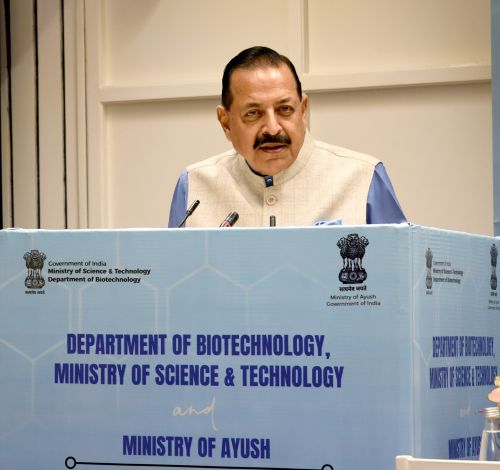
On the occasion of “World Tuberculosis Day”, India launches first-of-its-kind global clinical study integrating traditional Ayurveda with modern TB care regimens; another step closer to “TB Mukt Bharat”, says Dr Jitendra Singh
Modern science and traditional knowledge come together for holistic management with better outcomes in Tuberculosis: Dr Jitendra Singh
Patient-centric, integrated approach key to TB elimination; India seeing steady decline in TB incidence through innovation: Dr Jitendra Singh
Whole-of-science, whole-of-government approach to drive scientific validation of Ayurveda and transform TB treatment outcomes: Dr Jitendra Singh
Ayurveda shows strong potential as supportive therapy in TB care; study reflects India’s whole-of-nation commitment to TB elimination: Dr Jitendra Singh
NEW DELHI, March 24: India today announced world’s first-ever, landmark clinical study that will, for the first time globally, scientifically evaluate Ayurveda as an adjunct to standard Anti-Tuberculosis Treatment (ATT), with Union Minister of State (Independent Charge) for Science & Technology, Earth Sciences; Minister of State in the PMO, Personnel, Public Grievances and Pensions, Department of Atomic Energy and Department of Space, Dr. Jitendra Singh, describing it as a unique convergence of modern biotechnology and traditional knowledge systems to address tuberculosis in a holistic and patient-centric manner.
Speaking on the occasion of World Tuberculosis Day, Dr. Jitendra Singh said India, which accounts for nearly 25% of the global TB burden, has registered a significant decline in incidence to about 187 cases per 100,000 population in 2024, reflecting a 21% reduction since 2015. Quoting Prime Minister Shri Narendra Modi, he said, “The decline in TB incidence is an outcome of India’s dedicated and innovative efforts. Through a collective spirit, we will keep working towards a TB-free India,” adding that this reflects the country’s steady movement in the right direction.
Dr. Jitendra Singh said India has adopted an ambitious and accelerated pathway towards TB elimination, strengthening early diagnosis, universal drug susceptibility testing, digital adherence technologies, and patient-centric care under the National TB Elimination Programme.
Recalling the historical journey of tuberculosis, the Minister said there was a time when TB had no effective treatment and patients were isolated in sanatoriums, often facing fear and social stigma. He said tuberculosis had deeply entered social narratives, literature, and films, largely because of the absence of treatment in earlier decades. With the advent of anti-tubercular drugs and evolving medical science, the disease gradually became treatable, marking a major transition in public health.
The Minister said that despite this progress, tuberculosis continues to present complex challenges. Patients often suffer from treatment-related toxicity, undernutrition, immune suppression, and long-term pulmonary impairment even after microbiological cure. He added that the growing burden of drug-resistant TB further complicates the situation and calls for innovative and multidisciplinary solutions.
Dr. Jitendra Singh said tuberculosis cannot be seen in isolation, as communicable and non-communicable diseases increasingly coexist and interact. He pointed out the reciprocal relationship between TB and conditions such as diabetes, where each can aggravate the other, making integrated approaches essential for effective disease management.
Highlighting the role of the Department of Biotechnology, the Minister said DBT has been driving a wide range of initiatives in TB research, including host-pathogen biology, drug discovery, vaccine development, and genomic surveillance. He referred to the RePORT India programme, one of the largest TB research consortia, which has enrolled over 4,500 TB patients and more than 5,000 household contacts, generating evidence that has contributed to global policy frameworks, including WHO guidelines on nutrition and tuberculosis.
The Minister also referred to the Data Driven Research to Eradicate TB programme, under which several initiatives have been undertaken, including the Indian Tuberculosis Genomic Surveillance (InTGS) Consortium. He said more than 32,000 Mycobacterium tuberculosis clinical strains are being sequenced under this initiative, creating a valuable national repository to support drug discovery, diagnostics, and containment of drug-resistant TB.
Dr. Jitendra Singh said that even after successful treatment, many TB patients continue to experience weakness, weight loss, and compromised quality of life, underlining the need for supportive and host-directed therapies. The Minister said India’s rich heritage of Ayurveda offers unique opportunities for such interventions, particularly in improving nutrition, immunity and overall recovery.
Announcing the collaborative clinical study between the Department of Biotechnology and the Ministry of Ayush, he said this initiative is the first-of-its-kind not only in India but also globally, as it seeks to validate traditional medicine through rigorous scientific evaluation. He said the study reflects the spirit of “whole-of-science,” by integrating biotechnology and Ayurveda; “whole-of-government,” through collaboration between ministries; and “whole-of-nation,” with participation of over 1,200 patients across premier institutions nationwide.
Dr. Jitendra Singh said tuberculosis is too serious a challenge to be addressed by the government alone and cannot be left only to the healthcare system or families. He called for a collective societal effort involving communities, civil society organisations and awareness campaigns to remove stigma associated with TB, noting that patients often tend to hide symptoms due to social perceptions, which delays diagnosis and treatment.The Minister emphasised that alongside medical treatment, attention must also be given to nutritional recovery, lifestyle support and community-level engagement, as these factors play a crucial role in ensuring complete and sustained recovery.
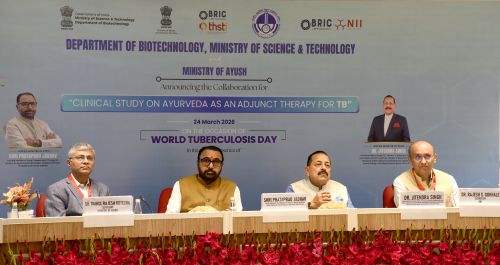
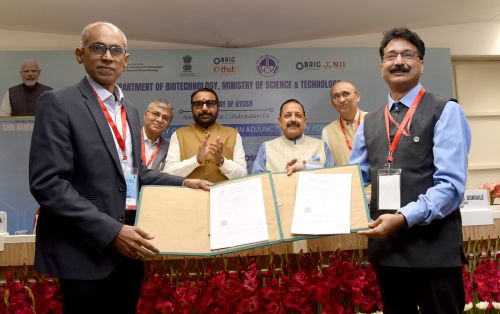
The event marked the launch of the collaborative programme between the Department of Biotechnology, Ministry of Science & Technology, and the Ministry of Ayush. It was attended by Union Minister of State (Independent Charge) for Ministry of Ayush, Shri Prataprao Jadhav; Secretary, Department of Biotechnology, Dr. Rajesh S. Gokhale; Secretary, Ministry of Ayush, Vaidya Rajesh Kotecha; Director General, Central Council for Research in Ayurvedic Sciences (CCRAS), Prof. Vaidya Rabinarayan Acharya; Director, BRIC-National Institute of Immunology (NII), Dr. Debasisa Mohanty; along with senior scientists, researchers and representatives from leading institutions across the country.
Providing an overview of the study, DG, CCRAS, Prof. Vaidya Rabinarayan Acharya said the initiative has been developed under the MoU signed between the Ministry of Ayush and the Department of Biotechnology on 25 May 2022 and has progressed through consultations, protocol finalisation, and approvals. The study will enrol 1,250 newly diagnosed TB patients across eight institutions and evaluate Ayurveda as an adjunct to standard treatment, focusing on body weight, nutritional outcomes, disease progression, quality of life, safety, and tolerability.
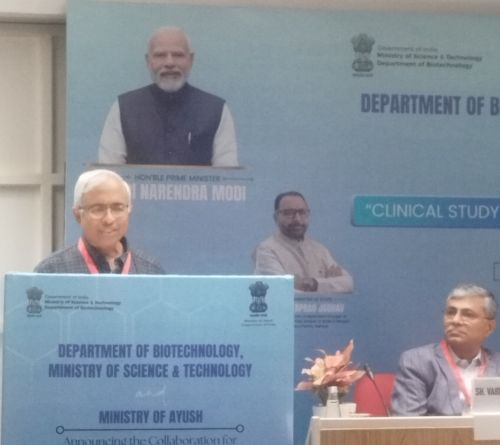
Director, BRIC-NII, Dr. Debasisa Mohanty said the study will also examine tuberculosis-associated cachexia as an immune-metabolic condition, using advanced tools such as DEXA, MRI, immune profiling, metabolomics, and single-cell RNA sequencing to understand changes in body composition, immune function, and energy metabolism, and to assess how integrative interventions influence recovery and long-term outcomes.
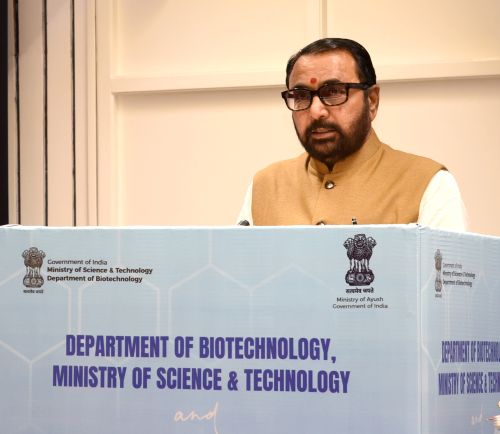
Union Minister of State (Independent Charge) for Ministry of Ayush, Shri Prataprao Jadhav said the initiative reflects a broader vision of healthcare where the focus extends beyond curing infection to ensuring complete recovery, improved nutrition, and enhanced quality of life through integration of Ayurveda with modern medicine.
DBT Secretary, Dr. Rajesh S. Gokhale said the programme builds on the Department of Biotechnology’s extensive work in TB research, including diagnostics, vaccine development, and cohort studies, and represents an important step towards generating evidence for integrative and patient-centric healthcare approaches.
Concluding, Dr. Jitendra Singh said the fight against tuberculosis requires innovation, integration, and collective responsibility at every level, adding that such initiatives will accelerate India’s journey towards a TB-free nation while setting a global example in combining traditional wisdom with modern science.