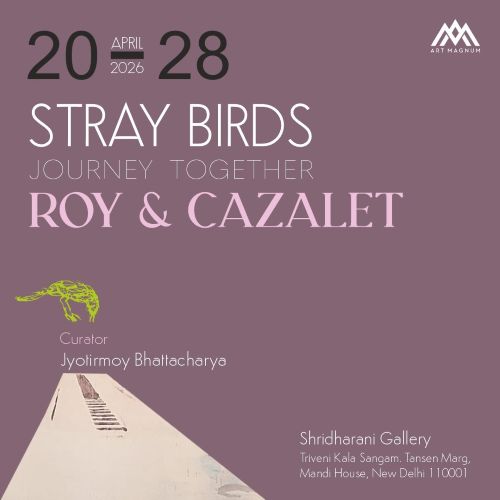
While walking through the roads of life, we often encounter moments that leave an indelible mark on us, quietly shaping the course of our future journeys. These moments rarely announce themselves. They emerge unexpectedly from the bedlam of chance meetings, spontaneous conversations, lived experiences, and unforgettable people. At the time they occur, they may seem fleeting or ordinary, yet in retrospect they reveal their profound significance. Life often feels like a journey along a flowing river, where the ghats (river banks) similarly resemble the many phases we move through childhood, discovery, struggle, transformation, and reflection. Each ghat represents a moment of arrival and departure, a pause that allows us to gather fragments of ourselves before continuing onward. Some of these phases remain vivid, while others seem distant or lost. But even the ones we believe we have left behind often leave residues in the deepest corners of our consciousness, shaping who we become. It was through reflections like these that the idea of curating this exhibition first began to take shape.
I found myself contemplating what could possibly connect two artists from different corners of the world, two individuals shaped by distinct cultures, geographies, and experiences. At first glance, their journeys appear separate, each following its own current. Yet life has a way of bringing people together through unexpected circumstances. Through chance encounters and shared moments, these two artists formed a friendship that gradually deepened over time. Indrapramit arrived in Baroda after completing his graduation in Santiniketan, making it a logical next step for him to enrol at M S University. Mark came to India as a Commonwealth Universities scholar in search of new experiences, and his 18-month stay here changed his life. However, his journey almost didn’t begin as planned due to a miscommunication between the university authorities when he first arrived. Professor Sheikh advised him to stay with another student, Sasidharan, while they assessed his admission status. During those initial days, Mark spent his time drawing in the streets of Baroda. When Professor Sheikh saw his drawings, he recognised Mark’s talent and made arrangements to accommodate him in the course.
This dialogue becomes particularly compelling when we examine the works of Indrapramit and Mark. Both artists are passionate about capturing life on the move, taking their sketchbooks everywhere and using them at every opportunity. Mark considers himself a magnum photographer, documenting life as it unfolds. Their creations are deeply rooted in the observation of spaces, people, and the subtle emotional currents that often go unnoticed in the rush of daily life. Indrapramit’s work reflects the layered complexity of experiences that often manifests as charged spaces obliquely referring to the human presence in their absence. For him, art cannot exist without politics, which encapsulates his career as an artist. Conversely, Mark approaches the world through a different yet complementary lens. His focus is on interpreting the human experience with a more sacred perspective on life. Despite their differing artistic vocabularies, the connection between the two artists becomes increasingly evident. Their works function almost like visual journals, serving as archives of lived experiences that preserve moments that might otherwise fade into obscurity. Through drawing, painting, and keen observation, they document the world around them while also reflecting on their inner landscapes.
In this sense, the exhibition becomes a conversation between two artists, between two journeys, and between two ways of seeing the world. Their works remind us that artistic practice is not merely about representation, but about understanding our place within the ever-changing currents of life. And perhaps, like the ghats* along a river, this exhibition too offers moments of pause, a space where memories, encounters, and artistic journeys briefly converge before continuing their onward flow.