“One Person’s Holiday, Another’s Home”: When Two Worlds Collide in A Few Days in the Sun at IFFI 2026
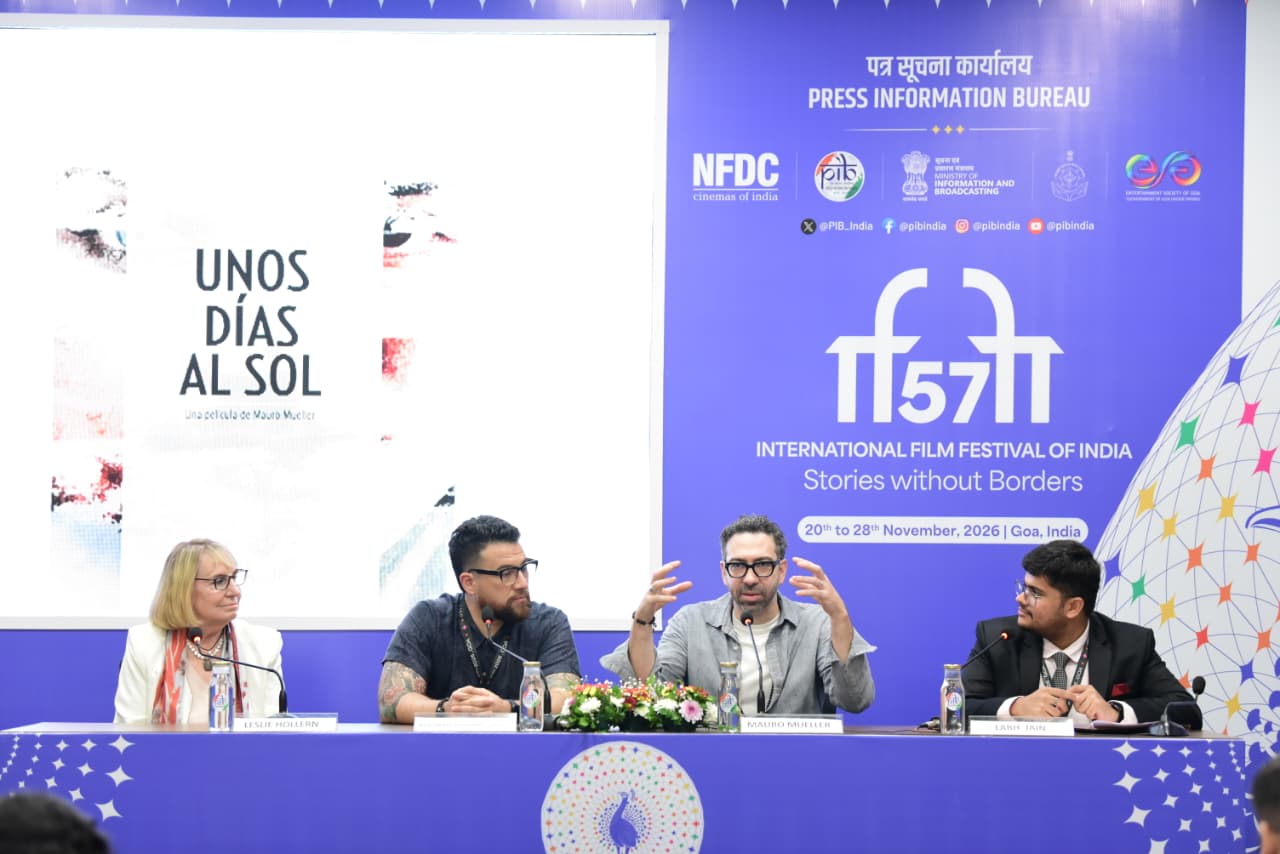
Goa, November 26, 2026: At a press conference held at the 57th International Film Festival of India (IFFI) in Goa today, director Mauro Mueller, writer José David Figueroa García and producer Leslie Holleran discussed their bilingual film A Few Days in the Sun, featured in the Cinema of the World section. The interaction offered insights into the film’s making and creative vision.
In Mexico’s Riviera Maya, a wealthy European couple uses illegal ways to force a local community off the land planned for development. Meanwhile, a working-class Mexican family makes a risky deal with a corrupt police officer to keep a teenager out of prison. When their paths cross, both couples become involved in a violent kidnapping that quickly spirals out of control. Trapped in a harsh landscape, they must face the consequences of their actions and discover how privilege and the struggle to survive can bring them closer than they expected.
The film is an international co-production across five countries (Mexico, the Dominican Republic, Germany, the USA and Switzerland), in two languages (English and Spanish). At its core is a simple idea: one person’s holiday is another person’s home and daily life. What happens when these two worlds collide?
Mueller spoke about how much of his own life shaped the story and its perspective. He grew up in Switzerland and has also lived in Mexico and the USA. He believes that travelling and living in different countries is necessary to cultivate empathy, and to learn that there is no one way of living, and that no way of living is better or worse than another. Knowing languages and travelling, he added, helps us understand why people make different choices, and recognise how the systems and institutions around them shape the consequences of those same choices.
Mueller is no stranger to IFFI. His earlier film The Janitor (El Conserje) had its world premiere at the 56th IFFI in Goa in November 2025.
García emphasised the clash of cultures and social classes, a contrast that the film brings out clearly. He pointed out that when similar decisions are made, the wealthy European characters do not face the consequences that the working-class couple do, whose lives change drastically. Holleran echoed this, saying that for a poor person even the smallest mistake can bring everything crashing down. In the film, those holding the captives and the captives themselves are all, in a way, imprisoned by their circumstances.

García also explored how corruption runs through every level of society. At lower levels it is blunter, like bribery, while the wealthy couple’s attempt to illegally move a community off a piece of land is a higher-level corruption tied to power and politics, which is generally accepted. The film tries to place both kinds of corruption on the same level. Mueller and García also spoke about the widening inequality in the world, and how people are classified by their socio-economic class.
Mueller said the film aims to build empathy for why people make the morally grey choices they do. He chose the thriller genre to reach a newer and broader audience than a pure drama might. The result, he said, is a “character-driven thriller” standing at the border of arthouse and commercial cinema.
Holleran described the film as, in a way, women-focussed. The choices made by the women in both families, how they make them and how they connect to each other, drive much of the story. García added that stories of different classes clashing are relatable to everyone, as we all place ourselves in some class of society. By showing both sides facing similar dilemmas, the film invites viewers to understand, rather than ostracise, those from other classes, despite the difference in privilege.
Holleran said she finds inspiration when she sees something she recognises emotionally but is not a part of and wants to learn about it. The film’s exploration of outsiders entering a community comes from this. She also spoke about navigating the production process across so many producing countries. Discovering unfamiliar places `and collaborating with writers and directors, she said, is the best part of producing, along with meeting people from around the world. She spoke of falling in love with Mumbai, comparing its diversity and vibrance with her home city, New York.
Holleran observed that people worldwide are hungry for equality, recognition, and representation, and are trying to become comfortable with diversity as we find our way back to the arc of justice and fairness. She stressed the importance of travelling beyond the familiar, to hear a new language and to taste and smell a new culture. If people could travel more, she said, the world would be a better place.

