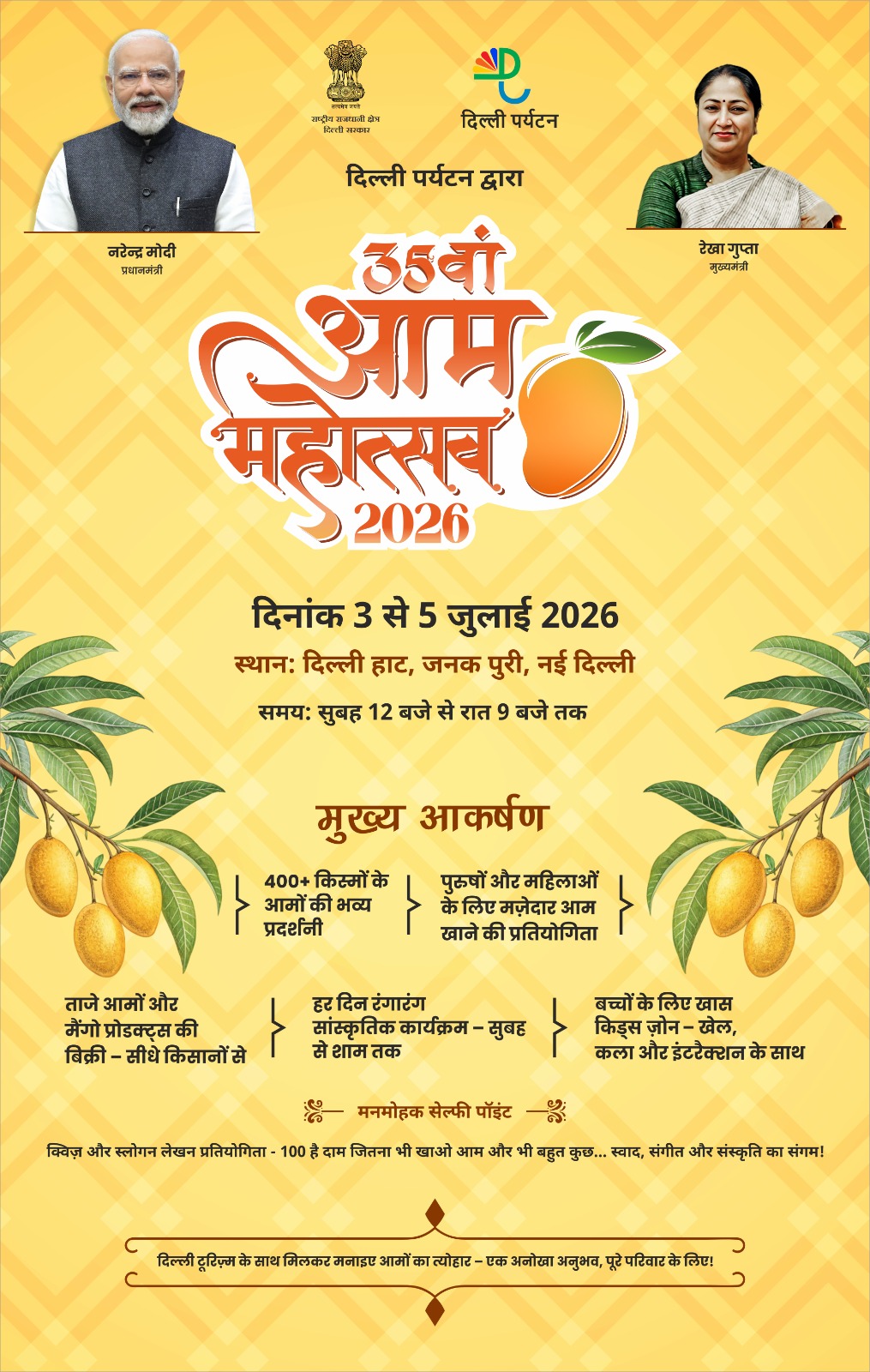
The three-day annual 35th Mango Festival, organized by Delhi Tourism, Government of Delhi, will be held at Delhi Haat, Janakpuri, New Delhi, from 3 to 5 July 2026. The festival is eagerly awaited every year by the people of Delhi.
Delhi Tourism has been organizing the Mango Festival annually since 1987. The festival showcases numerous rare and exotic varieties of mangoes, including Husnara, Rataul, Ramkela, Kesar, Mallika, Amrapali, Litchi, Fazli, and Hathijhool, among others. Visitors can also witness mangoes ranging in size from grapes to papayas.
Mango growers from across the country participate in the festival by exhibiting a wide range of mango varieties. Traditional orchardists, through generations of dedicated research and cultivation, have developed several new mango cultivars, contributing significantly to the diversity of this beloved fruit.
It is believed that mango cultivation in the Indian subcontinent dates back more than 4,000 years. India accounts for approximately 40 to 64 percent of the world’s mango production. Of the more than 1,500 mango varieties found worldwide, nearly 1,000 are grown in India. Mangoes are cultivated throughout the country, with major production concentrated in Uttar Pradesh, Andhra Pradesh, Odisha, Bihar, Tamil Nadu, Maharashtra, and Assam. Uttar Pradesh alone contributes approximately 25.76 percent of India’s total mango production.
The Charaka Samhita also describes the medicinal properties of the mango tree and its fruit. Mango is believed to help alleviate ailments such as disorders related to Vata, Kapha, diarrhea, and dysentery. Rich in carotene, mango also helps address Vitamin A deficiency in the body.
The great Sanskrit poet Kalidasa, in his classic work Abhijnanashakuntalam, vividly portrayed mango groves in spring with remarkable poetic beauty. The renowned Sufi saint and poet Amir Khusrau also celebrated the significance of mangoes in his writings. Depictions of mangoes can be found in Buddhist stupas, ancient sculptures, and throughout Indian cultural traditions. The mango has become deeply embedded in Indian life, finding its place in religious rituals, textiles, adornments, traditional medicine, and cuisine.
Today, Indian mangoes are also an important source of foreign exchange earnings. They are in high demand in the Gulf countries and Europe, making India one of the world’s leading exporters of fresh mangoes.
As in previous years, the 35th Mango Festival will feature participation from traditional mango growers, government organizations, and non-governmental institutions. Prominent participants include ICAR–IARI, Pusa; ICAR–Central Institute for Subtropical Horticulture, Lucknow; G.B. Pant University of Agriculture and Technology, Pantnagar; CCS Haryana Agricultural University, Hisar; Directorate of Horticulture, Uttar Pradesh, Saharanpur; Bihar Agricultural University, Sabour, Bhagalpur; Kisan Mango Society; Earth Mango Society; Malihabad Mango Farmer Producer Company Ltd.; Society for Conservation of Mango Diversity; Awadh Agritech, Malihabad; Tariq Mustafa (Uttar Pradesh); Rambir (Uttar Pradesh); Akhlaq Ali (Uttar Pradesh); Mohammad Shahid; Mohammad Junaid; and several other distinguished growers and institutions.
Visitors will have the opportunity to purchase a wide variety of fresh mangoes, mango-based products, and mango saplings. Major attractions of the festival include Mango Eating Competitions for both men and women, vibrant cultural performances, handicrafts and handloom stalls, a dedicated children’s play zone, selfie points, and an extensive range of food and beverages, offering visitors a memorable and enjoyable experience.