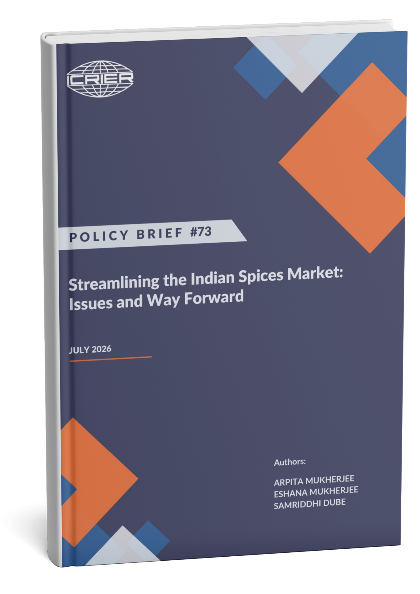
New Delhi, July 8, 2026: The ICRIER Policy Brief titled Streamlining the Indian Spices Market: Issues and Way Forward was released at an high-level expert consultation by Dr Ramesh Chand, Distinguished Professor, ICRIER and Former Member, National Institution for Transforming India (NITI) Aayog, Government of India, and Dr Raka Saxena, Programme Director – Agriculture Policy, NITI Aayog.
“Spices are not a minor commodity — they account for nearly one-tenth of the value of the crop sector. Given the sector’s rapid growth, there is a clear need to streamline the spice market, with primary focus on quality, food safety and standards,” said Dr Ramesh Chand, Distinguished Professor, ICRIER and Former Member, NITI Aayog in his remarks.
“Food safety is fundamental to strengthening India’s domestic spice sector. Building a comprehensive domestic database on food safety gaps is equally important to improve quality and strengthen the entire value chain,” said Dr Raka Saxena, Programme Director – Agriculture Policy, NITI Aayog.
“India accounts for over 40% of global spice production, yet FSSAI has standards for only 45 spices and Codex Alimentarius for just 14. Without these standards there is wide variation in product quality in the domestic market, leading to food safety concerns,” said Dr Shekhar Aiyar, Director & CE, ICRIER in his opening remarks.
A panel discussion followed the release. It deliberated on the inconsistent enforcement and implementation of the food safety standards and made various suggestions on uniform implementation of the standards. Panellists also flagged the need for stronger and more uniform laboratory testing capacity, persistent quality gaps in the informal and unbranded spice segment, and structural challenges facing smallholder farmers.
Speaking at the event Dr Arvind Kumar, Member, Scientific Panel on Spices and Culinary Herbs, FSSAI said “FSSAI not only adopts Codex standards; but actively contribute to their development. Through scientific risk assessment, consultations with research institutions, industry and farmers, and consensus-building, India can develop standards that are harmonised with India’s conditions while ensuring food safety.”
Key Highlights of the Policy Brief:
· The global spices market was estimated to be USD 27-30.5 billion in 2024 and is projected to reach USD 54.75 billion by 2033. India accounts for more than 40% of global spices production. However, the domestic market for spices for foods is growing at a rate lower than the GDP growth. Also, majority of the market (60-80%) is informal in nature.
· Missing Standards for Spices: India produces around 75 spice varieties. Of which, FSSAI has set standards for 45 spices. FSSAI is yet to set standards for some spices like kokum and vanilla. The multitude of varieties has ensured that qualitative characteristics are becoming the key differentiators.
· Multiple Agencies with Overlapping Regulations: Multiple agencies like the FSSAI and Bureau of Indian Standards (BIS) have notified standards for spices, resulting at times in overlapping standards and even conflicting requirements. There is a need for the domestic standards to be aligned to international Codex standards.
· Industry faces High Compliance Costs for Laboratory Testing: The lack of uniformity in testing procedures across spice testing laboratories of multiple agencies is increasing compliance costs by and estimated INR 25,000-30,000 per sample.
· Health Hazards due to Poor Farm-level and Post-harvest Practices: In-field practices are currently outside the jurisdiction of the FSSAI, where there is high use of pesticides and fertilisers, leading to health issues. Poor post-harvest storage and processing practices are leading to product contamination.
· Fragmented supply chain: traceability to farm is limited, companies continue to source from traders.
· Poor quality of adulterated spices and spices that do not meet FSSAI standards, leading to adverse health impacts.
Recommendations:
- Modernise Food Safety and Quality Standards: A single nodal agency should regulate the entire spices supply chain from farm to retail. FSSAI may work closely with state governments to establish farm-level food safety standards. These standards should be uniformly implemented and effectively enforced.
- Streamlining FSSAI can lead the international standards discussions as the host secretariat for the Codex Committee on Spices and Culinary Herbs. FSSAI could work with the industry and industry associations to identify the spices that need specific standards for different varieties.
- Streamlining the Spice Laboratory Testing: Uniformity in testing parameters across all the spice testing laboratories is needed to reduce variation in test results and reduce compliance costs.
- Collect & Collate Data on Different Spices: A detailed database with production and consumption data on all spices, their varieties, and their region of production should be prepared and maintained by the government through its designated agencies.
- Reduce Chemical Pesticide/Insecticide Usage and Improve Farm-Level Practices: Provide farmers with training on proper storage, post-harvest processing, and Good Agricultural Practices (GAP) to reduce contamination, and promote the testing of soil and water quality, and the adoption of sustainable farming methods.
- Technology Should Be Adopted and Implemented Across the Supply Chain: To establish farm-level traceability, industry associations should collaborate with state governments. Additionally, all aggregators/middlemen/traders should maintain records linking their spice supply to the farms.
- Establish Adequate Storage Infrastructure and Laboratories: The Centre can work with state governments to map the spice storage facilities and testing infrastructure available across the country and set up new state of the art laboratories and cold storage facilities.
- Invest in Capacity Building and Training for farm level practices, post-harvest drying and laboratory testing. There is need to incentivise unorganised and informal sector to formalise develop brand and packaged product.